5 Risks Your Organization Should Know Before Purchasing a Below-Market-Price Vaccine Refrigerator
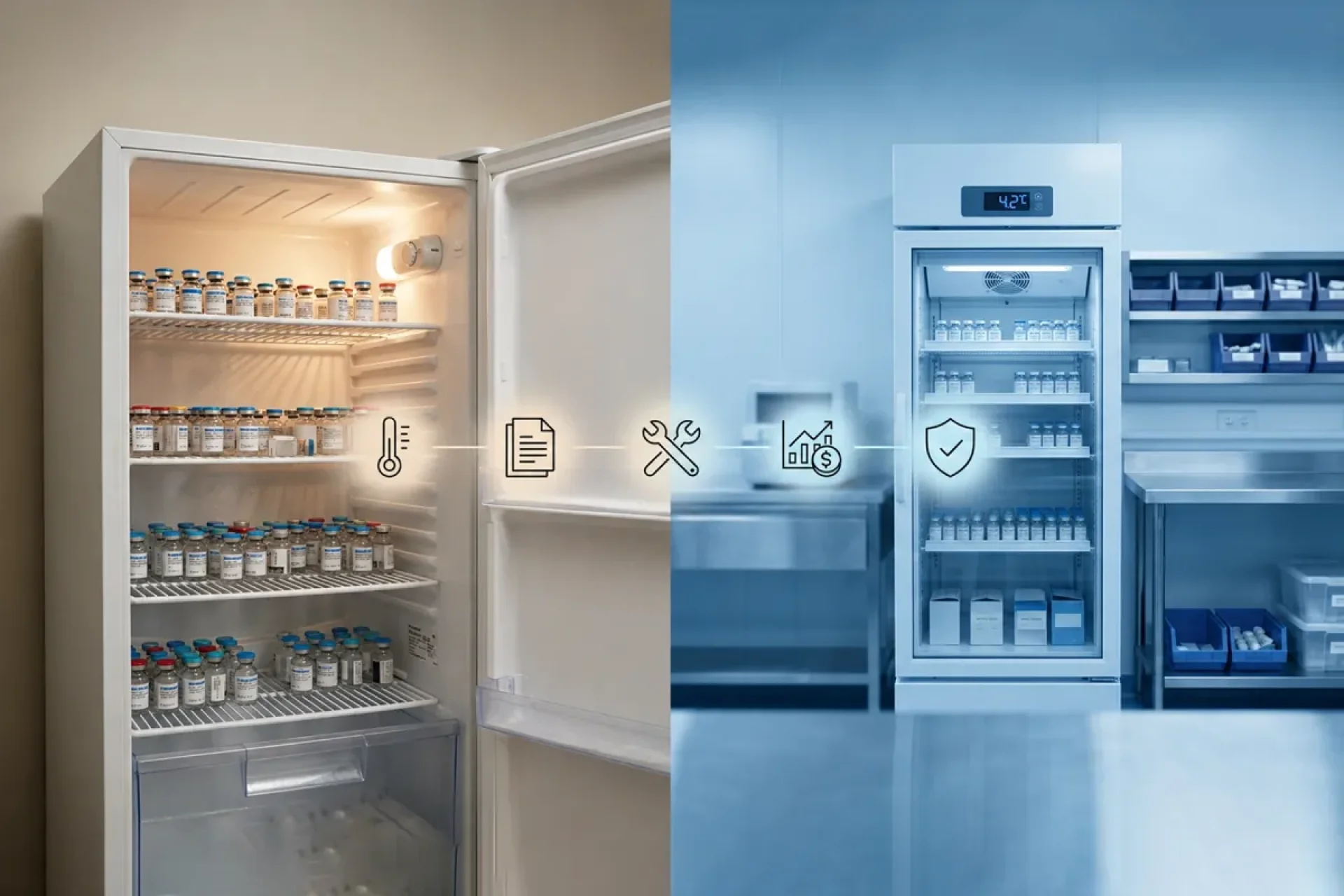
5 Risks Your Organization Should Know Before Purchasing a Below-Market-Price Vaccine Refrigerator
1️⃣ Temperature Stability Risk
Most vaccines must be stored continuously and stably within the 2–8°C range, in accordance with international Cold Chain standards. "Approximate" temperature control is not sufficient without data confirming long-term stability.
Questions to ask before deciding:
● Is a complete Temperature Mapping report available?
● Does it clearly specify the number of measurement points, test duration, and load conditions?
● Is there test data covering power fluctuations, power outages, or high ambient temperature environments?
2️⃣ Calibration & Traceability
emperature recording systems must be calibratable and accompanied by certificates traceable to international standards.
Without a clear calibration system, your organization may:
● Be unable to verify the accuracy of historical temperature data
● Risk failing quality audits such as QA or HA assessments
● Face uncertainty when investigating abnormal temperature incidents
In some cases, a below-market price may not include calibration services or long-term data monitoring systems.
3️⃣ After-Sales Service & Emergency Response Risk
A vaccine refrigerator is not the kind of equipment where you can "wait until it breaks to fix it," because vaccine losses can be worth many times the cost of the unit itself.
Key considerations:
● How many years of warranty are provided?
● Is a Preventive Maintenance (PM) plan included?
● Is the emergency response time clearly defined?
● Is there an on-site service team or authorized service center available?
In practice, the speed of problem resolution is a core component of public health risk management.
4️⃣ Total Cost of Ownership
The purchase price is only the initial cost.
The true total cost includes:
● Electricity consumption
● Maintenance costs
● Annual calibration fees
● Downtime costs if the unit malfunctions
● Vaccine losses in the event of a temperature failure
For example, if vaccines worth 1–2 million baht are damaged by a single temperature excursion, the resulting costs may far exceed the price of the unit itself. In some cases, a unit priced significantly below market may carry a higher long-term total cost than a fully equipped model.
5️⃣ Supplier Continuity & Transparency Risk
Vaccine storage is a mission tied to public safety. Choosing a partner should be a long-term decision, not just a one-time transaction.
Questions to ask:
● How many years of Cold Chain experience does the supplier have?
● Are there long-term organizational references available?
● Can the technical documentation be verified for its source?
● Can additional information be requested, or a visit to the manufacturing or assembly facility be arranged?
● Transparency and consistency of standards are the foundation of long-term trustworthiness.
Summary
Choosing a vaccine refrigerator is not simply a matter of comparing figures on a quotation — it is about managing vaccine risk, public safety, and organizational credibility.From over 26 years in Cold Chain systems, we have learned that careful decision-making from the outset significantly reduces problems in years 2 and 3 after installation.
Before deciding, always ask: Does a below-market price genuinely reduce costs — or does it simply transfer the risk into the future?